Beth Chatto and me


In 1988, I was 21 with a tiny baby daughter and—loving her aside—a serious case of not knowing what to do with my life. My family did not greet the news of my pregnancy with delight. My father’s response? “It’s not like a rabbit! You can’t leave it in a hutch and forget to feed it.” As you can imagine, an observation like this—coming from a man who once served me two of my pet rabbits (RIP Trog and Minty) for lunch, and who spent at least six months of every year working abroad in some rather gorgeous places—did not go down well.
Six months after her birth, I moved with my then partner to a little house in the countryside with a 100-yard garden. He was already a keen grower of carnivorous plants and some pretty formidable sinsemilla. In fact, he practically had to stage an intervention for the local bees, which would invade his greenhouses to gorge themselves before ending up completely stoned, sprawled across the staging like Cheech and Chong. He infected me with the gardening bug; I made him stop growing sinsemilla. After studying for an RHS Level III Diploma in Horticulture I started a small business designing garden borders and helping people manage their own gardens and I got my first print bylines, writing two articles for Amateur Gardening magazine about plant snobbery, and the therapeutic value of gardening for people with mental illness and/or addiction. It was one of the few times my father openly expressed pride, photocopying my work to show his colleagues.
We lived an easy drive from Beth Chatto's Gardens in Elmstead Market and visited often. I admired Chatto's gardening ethos which she credited to her husband Andrew, a skilled fruit farmer who extensively researched and wrote about the relationship between plants and their natural habitat. The garden is located in Essex, one of the sunniest and driest regions in the UK albeit beset by viciously cold winds that travel virtually unimpeded from places like Siberia before hitting the East Anglian coastal region (Elmstead Market is close to Clacton-on-Sea). The couple built a simple split-level house tucked beside a low gravel bank next to the fruit farm on a piece of land described by Beth as unremarkable where the "extreme variation in growing conditions, from starved gravel to soggy bog...intrigued them, the possibility lying before us of growing plants adapted to problem areas." Back in 1960, when she began shaping this now-famous garden, the idea that plants do best when planted in surroundings that best matches their original habitat was unfashionable, as was her decision to work with what they had.
Chatto's horticultural philosophy struck a chord not only because of its sound ecological/horticultural sense but because at that time I very much felt like a human 'problem area', transplanted into a life I was ill-prepared for, although my youth had afforded me a certain amount of blithe courage and determination. I had yet to fully grow into my changed circumstances and wasn't entirely sure what my natural habitat might be anyway. But I began to shape my own garden and design planting plans based on her principles and slowly my client list grew, spreading as far as London, sixty miles away.
About a year before my relationship broke down and I moved to London I visited Beth's gardens taking with me an old fiesta dress I'd worn as a child in Mexico to dance at some festival or other (there were a lot of them so forgive me for not remembering which one it was). The dress had a tiered skirt which flared out as I danced, augmented by several layers of stiff net, and was patterned with pink-hearted white daisies on a warm yellow background. I'd got it into my head I wanted to design a border for my own garden based on these colours which- at the time- was also controversial garden design-wise because of an old-fashioned tenet that pink and yellow together were an abomination; an affront to good taste.
As I wandered around Beth Chatto Gardens’ nursery clutching both my baby daughter and the old dress—the latter held up against plants to check whether they obeyed the “cool with cool, warm with warm” tonal rule, which is actually a pretty good rule of thumb, especially for a beginner designer—up walked Beth Chatto to ask what I was doing. “She looks like a little flower herself,” she said of my sunbonneted daughter, who, unbeknown to Beth, had been nicknamed “Blossom” by my grandparents.
Intrigued by my quest, Beth spent the best part of an hour helping me not only to choose plants, but also discussing gardening, design, and her work with young apprentice gardeners who stayed in a caravan on site to learn from her while helping in the gardens. We talked about the challenges inherent in combining pink and yellow within a border, and the gardeners who managed it successfully, how to avoid a 'municipal look' (although I do love municipal gardening for the stories it tells about plant trends), and established what kind of garden I had, soil and climate-wise. After plants had been selected, we walked to her tiny shop where she impressed upon me a signed copy of her recently-published 'Garden Notebook' and an encouragement to come be a student at her garden (sadly impossible at the time).
Her kindness is obviously impossible to forget; it has become part of my DNA, one of the reasons I garden day and night, propagating plants I neither need nor have space for, and honing the grafting skills first taught to me by my grandmother who worked in a rose nursery after years spent as a teaching assistant in another kind of nursery. And those early lessons were later refined during my RHS course. I worked in the same plant nursery as my gran during my studies, potting on, weeding, propagating, pruning, then cleaning thousands of pots with Jeyes Fluid in a freezing cold hangar where tractor loaders would slide in and out to dump fresh potting compost onto benches regardless of whether we were in the way or not. Friday lunchtimes saw us pile into a trailer hitched to the tractor to be pulled to the nearest pub. Glamorous it was not.
Nearly forty years on I garden wearing whatever outfit I happen to have on at the time. I have never worn or bought “gardening clothes”; I do not own a wicker trug; I am not a fancy gardener. More than once, I have practically been ordered back inside because it was two in the morning. Tip my shoulder bags upside down and out will come cuttings, random leaves, and a smattering of dirt. I don't try to squish square pegs into round holes: pots apart, the plants in my garden are there because they suit the conditions, requiring minimal watering once planted and settled. I choose plants according to Beth's principles, having accepted that there is no point trying to grow the hauntingly blue Meconopsis baileyii I first saw threading its way through a small meadow at Kew Gardens or Enkianthus campanulatus whose delicately-traced flowers are positively Art Nouveau, both of which would hate my alkaline soil. I have foregone the waterloving Gunnera under whose giant multilobed and backlit-on-a-sunny-day palmate leaves I long to sit and read. My not-damp walled town garden is not the place. Her philosophy saves a lot of money and despair. I don't have to witness my plants struggling to survive, something that is important to me, being a person struck by rage when they see neglected plants in garden centres and nurseries. Beth felt the same; to her, plants were living creatures and we have a responsibility to them, particularly if they are held captive in pots, utterly dependent on the care of humans.
And Beth Chatto’s books continue to feel revelatory. Each rereading is as fresh as my garden first thing in the morning, when I open the kitchen door to discover what has changed overnight.
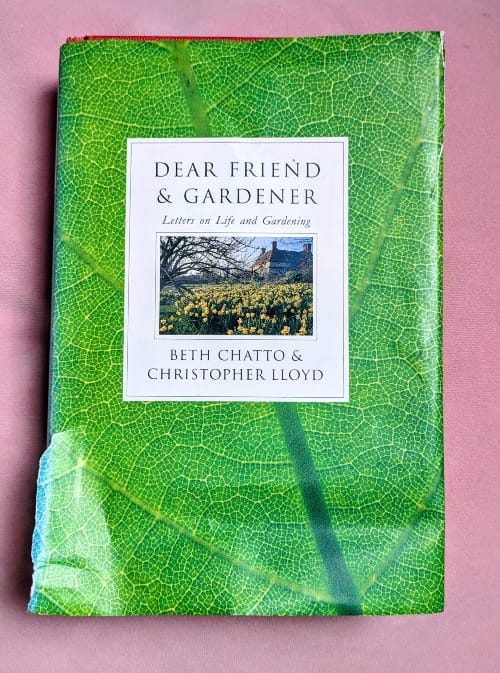
Last week I passed by one of the bookcases on the landing and pulled out 'Dear Friend and Gardener: Letters on Life and Gardening' by Beth Chatto, co-written with fellow horticulturist Christopher Lloyd, and commissioned by Frances Lincoln as a series of organised ('contrived') letters to reflect their already longstanding correspondence. It was published in 1998.
In the introduction, Christopher Lloyd describes the tensions that arose during the first months of writing, when their publishers cautioned them against mentioning “elitist matters” such as visits to Glyndebourne or his receipt of an honorary doctorate. They disagreed and prevailed. “A rounded picture of our lives would of necessity include much that is non-horticultural,” Lloyd writes. He was right. Yes, these are letters written in the knowledge that they are to be published which some readers have complained about, calling the process 'inauthentic' but if you are already acquainted with Chatto and Lloyd's usual manner of writing and speaking, you'll find these letters- and their tone- familiar. I was struck by how beautifully Beth writes about food and cooking in a natural and rhythmic cadence that feels effortless although excellent writing rarely is. I hadn't picked up on this before. Christopher Lloyd did go on to write Gardener Cook, published in 2001 and photographed by Howard Sooley but Beth was not a food writer, nor would she have described herself thus. Yet crucially, this adds appeal to descriptions of her vegetable plot, the ingredients she grows and shops for, and meals cooked with them. You wouldn't buy a Beth Chatto book specifically to read about food, but her writings on the subject, scattered amid lengthy prose about plants and gardening, are all the lovelier for this.
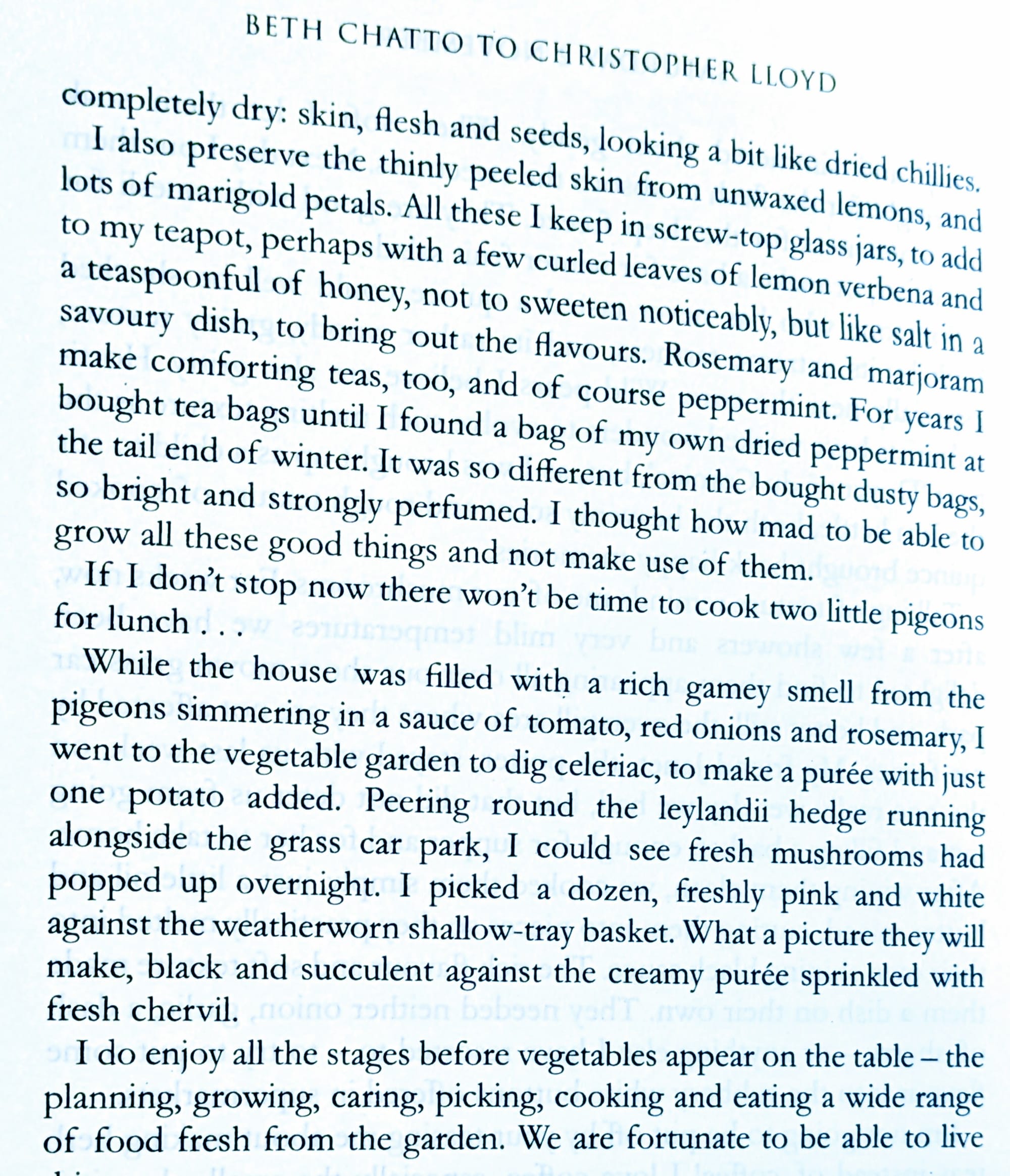
Dear Friend and Gardener's 249 pages are peppered with the names of fruits and vegetables grown and harvested, along with countless small observations . There is the salsify Beth grows after moving it from “a pace we wanted to sterilise … it doesn’t seem to have noticed,” which she promises to cook for Christopher on her next visit to Great Dixter using “a lovely Italian way … you boil the roots, then add the grated rind of a lemon, chopped plain-leaved parsley and a chopped small clove of garlic a minute before serving.” Her August crop of hips from Rosa rugosa are “big as small tomatoes, juicy and red.” She removes their calyxes before simmering the hips into a thick syrup, which she strains through muslin, sweetens with honey, and perfumed with an overnight infusion of leaves from a rose geranium.
Elderberries are preserved too, although Beth recalls finding the syrup she was given as a child whenever she had a cold “so disappointing, not a bit like blackberries.” Instead, she redeploys rose geranium leaves and honey to flavour her syrup, adds basil leaves to white wine vinegar (“the vinegar which had purple basil leaves is faintly pink”) and remarks how “forlorn” her vegetable garden looks on Christmas Day as she grates horseradish root into sour cream and garnishes it with chervil to dollop onto “bowls of bland vegetable soup.”
In the weeks before Christmas, Beth crops the young tips from “especially lush carpets of chickweed,” using them chopped like parsley. Christopher describes his Christmas decorations, including a tree festooned with “fine-spun glass birds” stored in a box marked, in his mother’s handwriting: “Glass Birds Bought at Harrods with Xr. (my family’s abbreviation) 1936. I was 15.” In the days following the festivities, he makes a fish soup with potato, garlic, and celeriac, the latter saved from frost beneath a double layer of hessian sacking. The green parts of his leeks are clogged with ice; his kitchen is so cold that the bottled olive oil has solidified. He reminds Beth to put some Seville oranges into the freezer because “they are so useful during the year, for flavouring sauces.”
The lettuces in Beth's polytunnels are slowly succumbing to botrytis because she refuses to spray them, but her chicories—“narrow red-leaved Treviso” and “big creamy-green” Sugar Loaf—are thriving. Christopher describes his own Sugar Loaf chicories as looking “terrible from the outside” due to the bitter weather, although their protected hearts remain “perfect.” He bakes brown bread to serve with purple sprouting broccoli cooked according to a recipe by Jane Grigson, with chopped anchovies, olive oil, wine, and stoned black olives. Beth writes about placing a frozen loaf directly into the oven because she forgot to thaw it overnight, and how, upon returning with more logs for the woodburner, the kitchen smells of woodsmoke and warm bread. Vegetable seeds are being tested for viability in pots; sea kale pots and straw have been heaped over the rhubarb; and she tells Christopher she remembered to freeze some Sevilles.
Come July, Beth grows young carrots “as sweet as honey” and new potatoes “the size of bantam eggs,” grown in a bucket as an experiment. She travels to Germany, where, framed by forested mountains “with high open meadows in the clearings … and small red-roofed villages tucked into the creases of the valley,” she eats at a table laden with “great bowls of salads, all kinds of soft cheeses mixed with herbs, crusty rounds of farmers’ breads, and tender steaks of grilled lamb. Two wooden casks provided red or white wine. Huge fruit flans—cherry, raspberry, apple, and apricot—with bowls of thick cream went well with good coffee …”
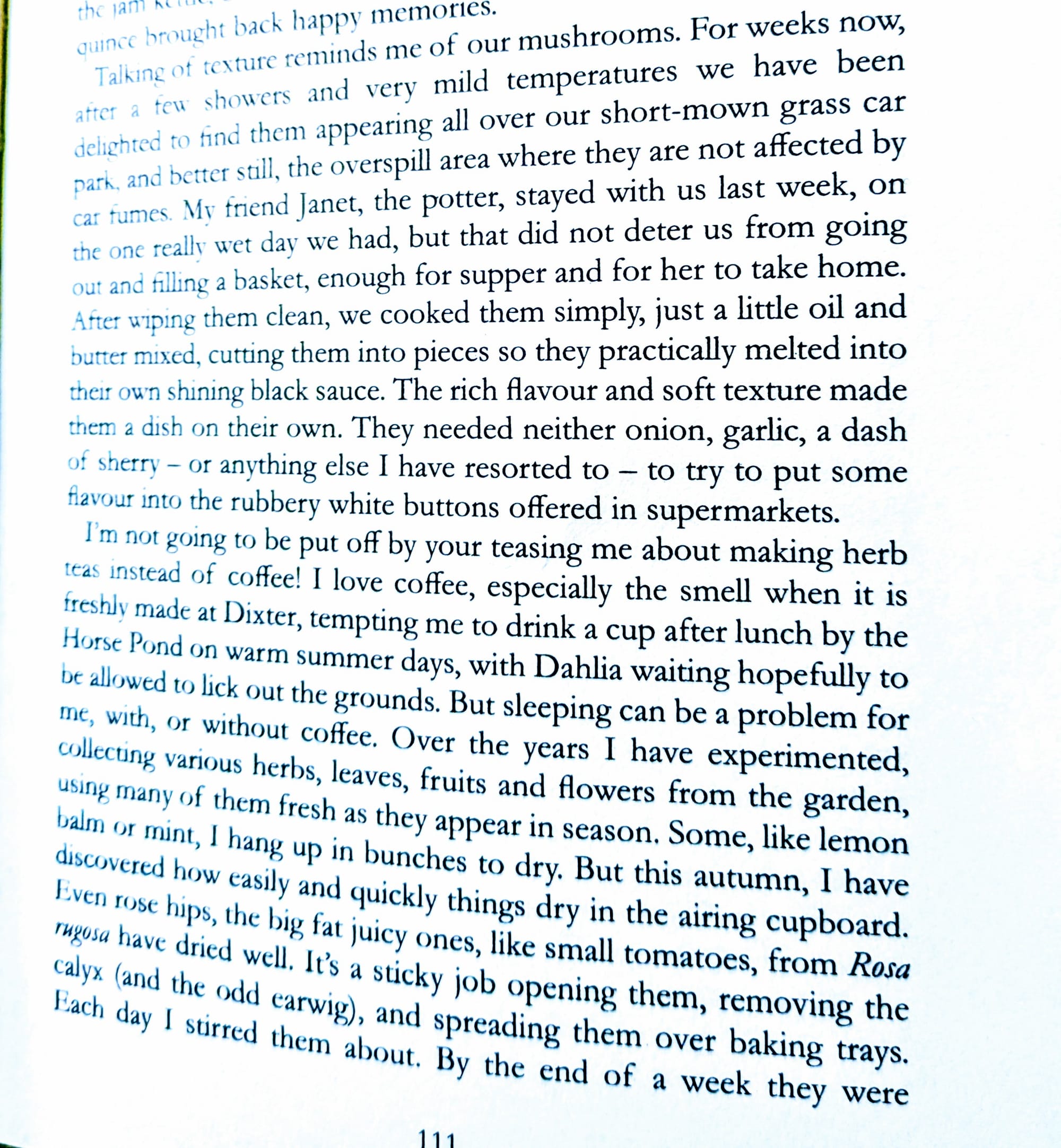
At the height of summer, she writes about “Baron Solemacher strawberries smelling like strawberry jam on this hot humid air” and the cucumbers she transforms into chilled drinks. The tomato house, after a slow start, “feels like a tropical jungle,” and they eat the first pickings of her favourite “violet-coloured, silky-textured runner beans,” simply steamed and eaten as they are. As Autumn takes hold, mushrooms become a constant presence in Beth's kitchen. She describes how they practically melt into their "the shining black sauce" after cooking, and responds to Christopher's teasing about her homemade infusions thus:
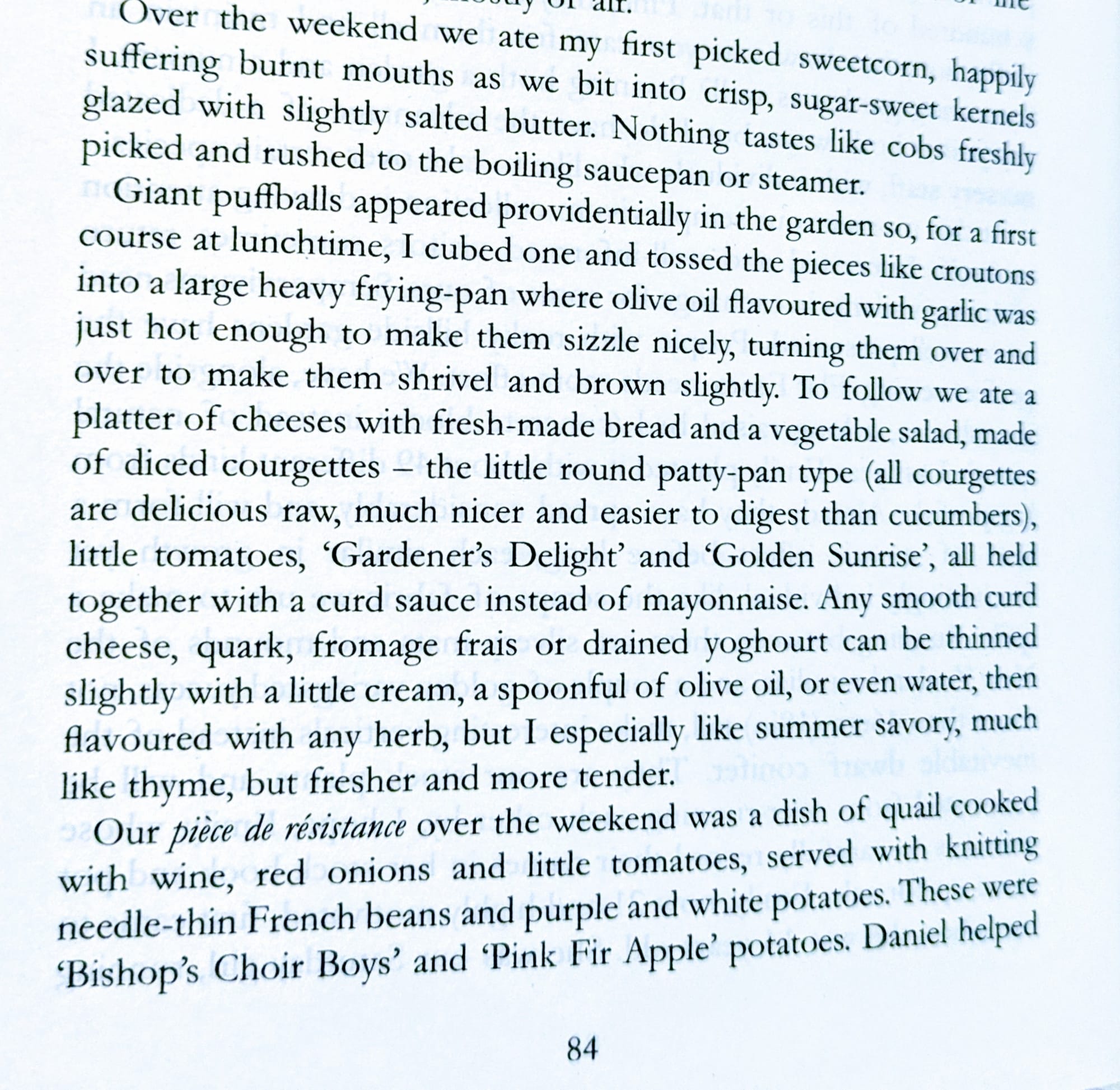
Still on the subject of mushrooms, I love this passage about a weekend feast where puffballs were served:
Christopher Lloyd waspishly criticises Sissinghurst Castle Garden’s overreliance on Rosa Iceberg (“the shrub has no style”) while eating a sandwich and a bowl of raspberries. He writes to Beth to tell her of his trip in July to Scotland where he cooks kedgeree using the local smoked haddock, “followed by a large steamed chocolate pudding—my mother’s recipe”—and Delia Smith’s Spanish Pork with Olives, “the best casserole stew I know,” before launching into a lengthy exposition on his mother’s so-called Danish Pudding.
"A layer of apple (already stewed if the apples are hard, but they were soft), a layer of chopped dates, a layer of marzipan, made with ground almonds, sugar and egg yolks,” all cooked in a slow oven before being covered with “stiffly beaten egg whites (difficult without an egg whisk, to get them really stiff) and granulated sugar folded into them and baked for a further half hour. When cold, cover with whipped cream and a scatter of toasted flaked almonds (if you have them). This is always popular and the recipe was taken down by more than one.” The lack of an egg whisk will resonate with anyone who has ever tried to cook in a holiday rental although his holiday let, a (probably quite well-appointed) cottage overlooking the Sound of Mull was owned by Sarah Raven, the wife of Adam Nicholson, the grandson of Vita Sackville West.
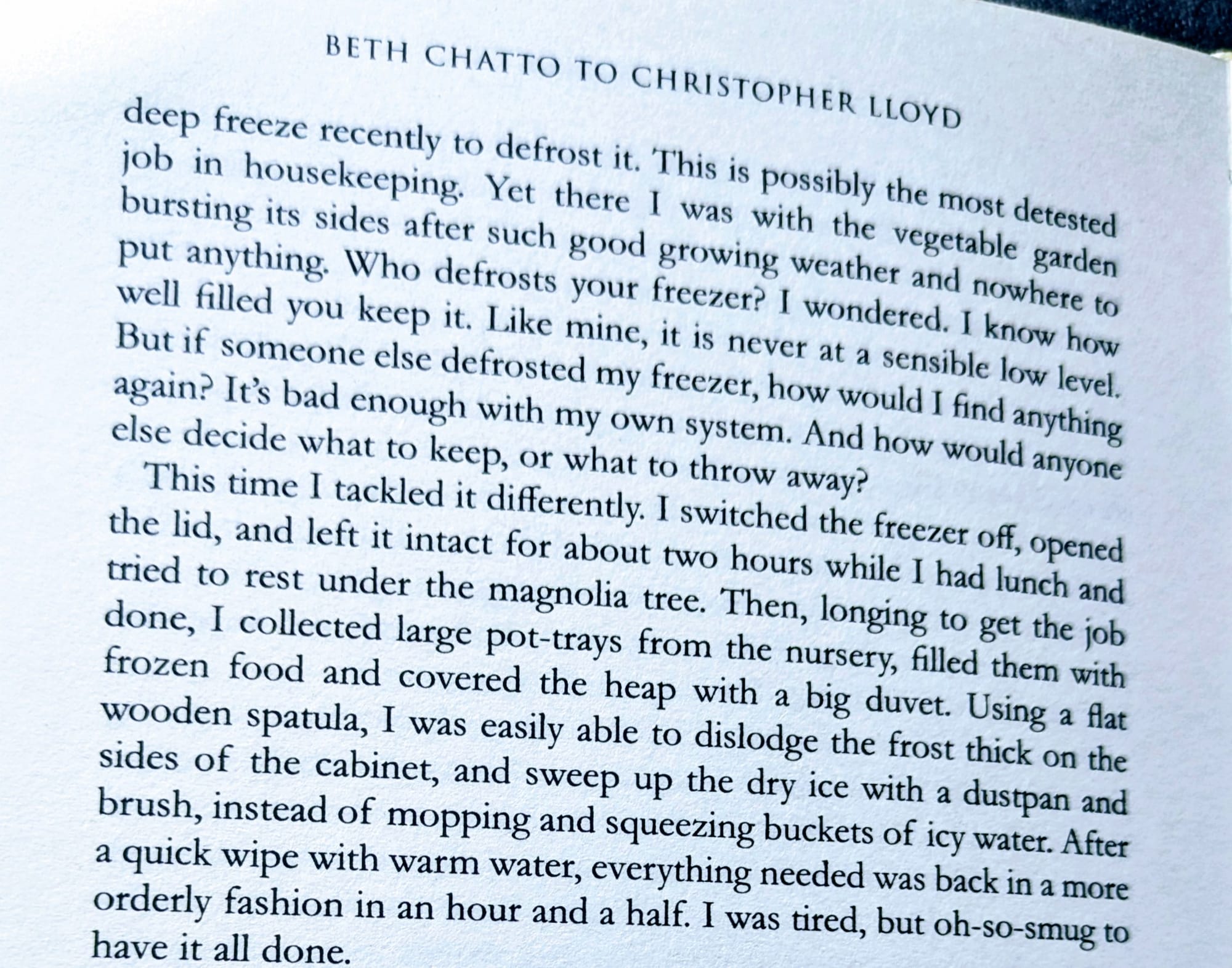
Accompanied by her twin brother, Beth drives to Hadleigh “through several miles of tortuous lanes, uphill and down, past little gardens spilling flowers and vegetables almost into the road” to buy locally milled wholemeal flour, which she likes to “buy fresh, then put … into plastic bags into the freezer, since I cannot buy it fresh each week as you (Christopher) do.” She then visits a friend who serves cake decorated with marigold heads and, a few days later, embarks upon “possibly the most detested job in housekeeping”—defrosting the freezer.
“Sometimes I wish I could switch off my mind as easily as I did the deep freeze recently to defrost it,” she writes, alluding to the depression and anxiety she experienced from time to time and, at the time of writing, her understandable distress over her husband’s declining health; he was suffering from end-stage emphysema, eventually dying in 1999.
The 'freezer' passage is too long to quote in full, yet too interesting not to share so here's a screenshot. Beth’s defrosting methodology and its entertaining delineation somehow becomes more than the sum of its parts, representing everything she was: problem-solver, cook, vegetable grower, and eater.
November arrives to see them discussing the iminent marmalade-making season, something Beth no longer does, not having a house filled with hungry mouths to feed. She doesn't make jam either but one of her daughters keeps her supplied. There is a wistfulness at play here as she tells Christopher of her admiration for his pots of quince jam whose "big chunky pieces of fruit (are) set in deep coral-red jelly" and his "Heath Robinson-like contraption of crossed lathes and homemade hooks" used to suspend the jelly bag over the long kitchen table at Great Dixter, one of the "many old kitchen implements you use, little habits and disciplines (taught me also by my mother)" which, she writes "add considerably to the pleasure of staying at Dixter." Both of them children "brought up in wartime never to waste," she nonetheless admits to transgressive moments in his kitchen, "throwing away perfectly good greaseproof paper, used to cover the scales before weighing dry ingredients, instead of dusting it off and returning it to its proper place," which made me laugh, this reminder of Beth's subtly maverick approach not only in how she gardened where she espoused a philosophy way ahead of its time, but in other parts of her life too.