On collecting-and reviewing-cookbooks


,February's food show on Suffolk Sounds Radio show was on the subject of cookbooks; how I decide which ones to add to my collection, and the criteria I use when choosing books for inclusion in my regular book roundups for this newsletter and my column for Suffolk News (I'm currently writing my spring round-up). The context: decluttering.
Some links go to my affiliate Bookshop.org store. Should you buy, I will earn a small commission.
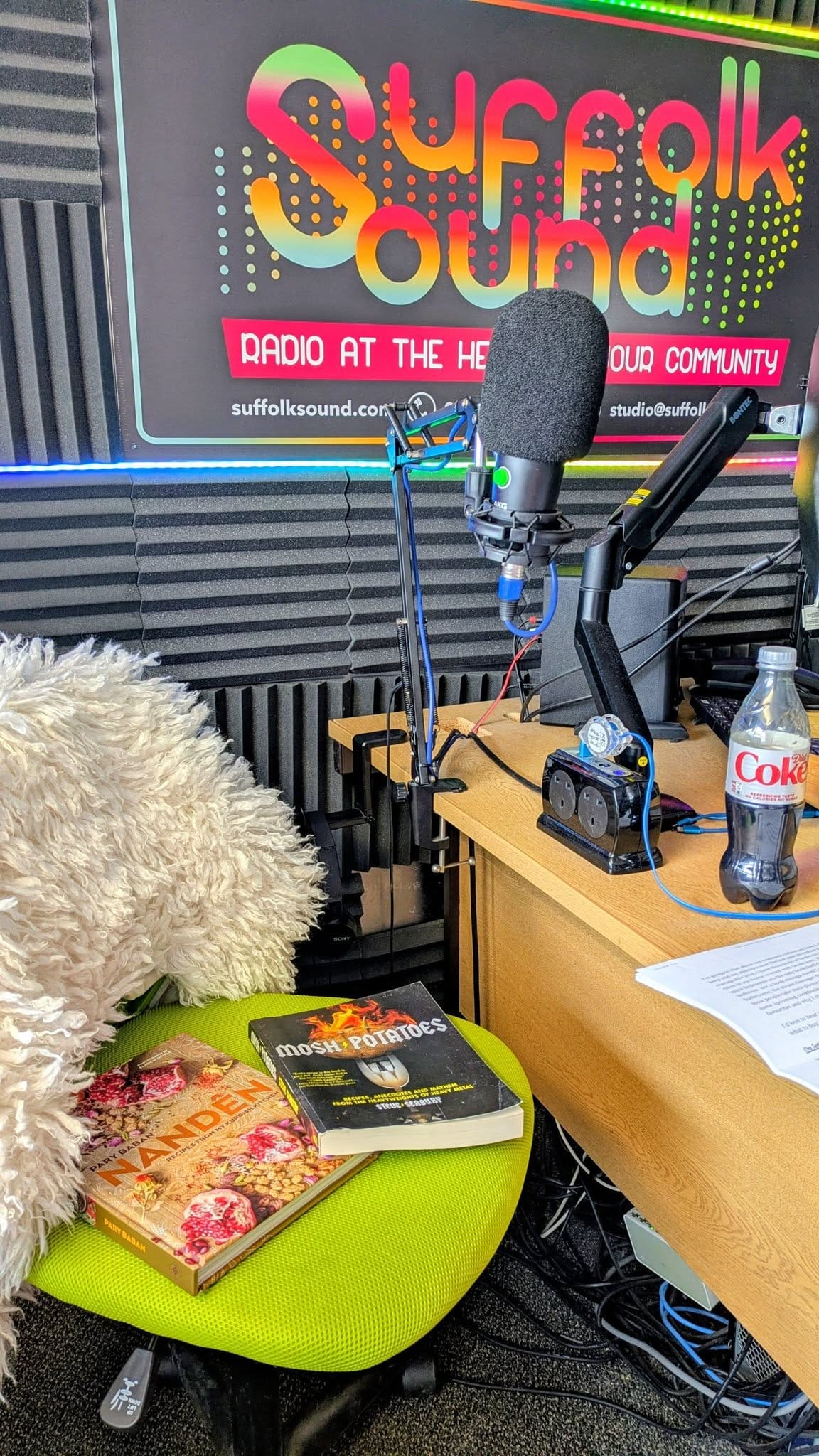
Here are my notes. Ran out of time as usual so some of these points weren't included in the show.
Over the last year I have been reducing my collection because I've been Swedish Death Cleaning (aka Suffolk ADHD Cleaning which is a clue to how it has been going lol). More than 1000 cookbooks and books on food have been sold, donated or binned (the latter only if they are unfit to pass on for whatever reason). NB: my host Karen Cannard tried to pin me down on exact numbers but all I'll say is my collection has fewer than 10k books but more than 6k. I'm a bit embarrassed about it which, if you listened in, is obvious. (catch-up link is here. Apologies in advance for my 'yep/um' verbal tics. Think of this as active listening gone rogue.)
On letting books go
It’s been hard. My dream has always been to establish a reading room filled with my collection and that of others, for members to spend time in, reading, cooking, attending talks and events. But it would cost far too much, and Bury St Edmunds is not the right location. Reducing my collection is part of my acceptance that this isn't going to happen. So I just cannot keep them all. The only downside is letting a book go, only to find you need it for something specific two years later. I have had to repurchase books. As for digital cookbooks, I dislike and never use them; my brain simply does not absorb or appreciate design and literature in digital form. I like a physical copy.
When I last judged the Guild of Food Writers First Book category, my postman was visibly nonplussed by the huge boxes of books arriving every other day. He even commented on it when he bumped into my husband in the pub! For a book lover, it was heaven — free books. But I already owned around 60 per cent of them and couldn’t keep them all, so they were donated to a local prison library. In total, they received around 50 books. Cookbooks with lots of photographs and beautiful design are great for imprisoned people, many of whom struggle with reading literacy. I tend to prioritise books with decent photography, and take into consideration font and typography so people with dyslexia or visual impairments aren't unnecessarily disadvantaged. Cookbooks are a source of sensate pleasure in an aesthetically unpleasant environment.
This year, I hope to repeat the exercise after asking fellow local Guild members whether they’d like to donate unwanted cookbooks. Another judge has already offered to send theirs me once judging has finished, which is amazing. Hopefully I will have enough books to donate to other social organisations too.
One of my core memories of the power of physical cookbooks dates back to the scrapping of the Net Book Agreement, which meant that large retailers could discount the recommended retail price — often to the detriment of small businesses who could not buy cheaper and in bulk.
My then mother-in-law owned a village shop that functioned as a newsagent, toy shop, sweet shop and bookseller. She took great care in selecting and displaying her stock. When Delia Smith’s How to Cook series was released, I accompanied her to Bartrams in Norwich, an enormous book wholesaler. We spent a happy few hours wandering its vast aisles, choosing new stock, including Delia’s book.
She worried about having to sell it at a higher price than the big stores. But after we spent considerable time on the window and the in-shop display, customers came in and bought it. I have never forgotten the buzz generated by that one book — or how wonderful it felt to be part of it all. I saw firsthand the power of a physical cookbook. (I think my first cookbook was A Young Cook's Calendar by Katie Stewart which I have kept. Another was the Be-Ro pamphlet originally owned by my grandmother; I had to buy my copy, my grandmother's being lost to time. The recipe for Boiled Fruit Cake is my tried and tested.)
I know most of us cannot afford to buy loads of books, so I remind readers to order them from local libraries, and I have written about some of my favourite regional secondhand bookshops with great food sections.
Over the last few years, I have been receiving books from publishers to review in my food column for Suffolk News (ten years old this May!), and of course, this newsletter, Tales From Topographic Kitchens. It’s been going since 2017, and the archives are stuffed with essays, interviews, reviews, and links to great food writing and media. I estimate I buy about 60% of my books; the rest are from publishers. So…. there’s a lot! I often ask for PDFs when requesting review copies from publishers to save space and their money.
How do I decide what books to buy and keep?
There are particular kinds of books I collect, and to be honest, if I see one that falls into those categories, I’ll try to acquire it. They don’t have to contain accurate — or even cookable — recipes, or be “good quality” in the sense of being beautifully edited and designed. Vintage books can be pretty basic, design-wise. What I look for in a cookbook as a collector and documentor is very specific. They must entertain and amuse me in the widest sense and, in the case of newly-published books, add to an existing body of knowledge, challenge or reframe it refreshingly or originally. I am prose-led; many of my favourite books about food have no photographs and few illustrations. But I know that other readers appreciate photographs showing what a recipe looks like once prepared.
My cookbook and food-writing passions include: kitsch and camp; North American regional cooking ( the American South and Mexico in particular because-yes- Mexico is in North America!); books about pie; film, book and TV tie-ins; Christmas and other festivals; Mexican, Greek, and regional African cuisines. I also adore super-niche, single-subject books where authors really drill down into one thing. But my collection covers everything- even cooking in the Antarctic- which might come in handy because my son is based there for the next few months.
Kitsch and camp
One of my biggest collections is the kitsch and camp category. I’ll never sell or give away any of these. Some of my faves: Liberace Cooks! The Gay Cookbook by Chef Lou Rand Hogan (actually pretty revolutionary), Venus in the Kitchen, a book about historical aphrodisiacs with a fondant pink cover. Barbara Cartland’s cookery book is divinely saccharine and old-fashioned even though I detested most of her views. I do like collecting cookbooks aimed at brides setting up home (published between the forties and early sixties) which sit next to the Pornstar Cookbook.
I have cookbooks from firehouses and firemen — one from the Beaver Falls Firehouse is titled Burnt Offerings. They are an amazing blend of camp and blunt force masculinity. I own an entire run of American books devoted to using your car to cook on the road (one is called Manifold Destiny) that are all about the romance of the highway, road trips, being a hobo, and limitless possibilities. I have Biker Billy's Hog Wild On a Harley, too. There’s a collection of recipes by roadies and rock stars titled Mosh Potatoes — Lemmy contributed a recipe called “Krakatoa Surprise”, in which flour, chocolate syrup, refried beans and curry powder are mixed into a heap, then strawberry sauce (“lava”) and rum are poured over the top and set alight. Another music-themed cookbook is called Dark Side of the Spoon. Quite a few of my Christmas cookbooks are pretty kitsch. The Dead Celebrity Cookbook Presents Christmas in Tinseltown is, perhaps, the epitome.
I have books on what dictators like to eat; what to serve in a bordello; how to feed cowboys; books about funeral food, which can be spectacularly kitsch; books about cooking in American prison cells (some painfully grim, others scholarly, a few amusing); and a book I've written about previously called True Grits, containing recipes inspired by John Wayne. Ernest Matthew Mickler’s White Trash Cooking has to be mentioned too.
TV, book, music and film tie-ins
Some of my collection (there are hundreds!): the Heartbeat Cookbook. Cookbooks inspired by food eaten in books by Laura Ingalls Wilder. Mafia-themed cookbooks are a particular pleasure: two notables are The Sopranos Cookbook and The Corleone Family Cookbook. (I even wrote a recipe I called 'Tom Hagen's Risotto'!) Fannie Flagg’s Whistlestop Cafe cookbook is lovely. I have Kevin Geddes brilliant books about Fanny Craddock. The Gremlins cookbook is ridiculous but cute. Vincent Price’s cookbook is pretty good. I have the Some Like it Hot tie-in, several by Sophia Loren, The Sinatras, Aunt Bee's Mayberry Cookbook from the Andy Griffins Show, the Treme Cookbook (and Princess Tiana's cookbook because Tiana was inspired by Leah Chase) cookbooks inspired by The Golden Girls, Zuzu Bailey's It's A Wonderful Life Cookbook, and the I Love Lucy cookbook. There’s even a Casablanca-themed cookbook called ‘Wining and Dining at Rick’s’. I am hoping to see a Heated Rivalry or Pillion tie-in. I'm drawn to kitschy book titles, Give My Swiss Chards to Broadway: The Broadway Lover's Cookbook being a great example, and collections of filmstar recipes from Bollywood to old Hollywood.
There are many subcategories: Halloween and horror themes are well-represented on my shelves, and cartoons like Peanuts and the Muppet Picnic Cookbook (actually a booklet). Most of these do not contain impressive recipes but they amuse me and are of their time. A few years ago, I was even asked to ghostwrite a cookbook for a super-famous rock star but he got sick and died. I can’t say who. I reckon I own most of the cookbooks written by American musicians and bands. They are almost universally terrible in their methodology but tell a story of loneliness, long hours away from family and home and trying to recreate communality on tour, love of fellow band members, the desire to maintain one's image even when talking about the most domestic of topics (Lemmy's recipe being a case in point), and the highs and lows of tour catering. Reading between the lines is always enriching.
Pie
I have hundreds of books about pie and pie-making, partly because my grandmother made pastry once a week. My grandfather ate it every day, and to save time, she would bake huge slabs of rough puff and shortcrust, cut them into squares and freeze them. Each night she’d defrost one, heat it, and serve it with whatever fruit was in season. I learned to make pastry by her side.
Pie books say home, safety and love to me — and labour too. Cooking is not always a beautiful, calming experience. Blessed are the pie-makers. I’m particularly fond of American pie cookbooks, which feel doubly comforting. I once wrote a piece for Delicious magazine about the relative lack of sweet pies in UK cafés. If we’re lucky, we get apple; mince pies at Christmas; and perhaps a pecan pie or two. The Americans can teach us a thing or two here. I love the pie cases in diners and cafés there: shelf after shelf of pies, arranged like priceless exhibits in a museum.
How I use cookbooks
What I read influences me at a more subconscious level.
I don’t necessarily buy cookbooks to cook from them. I own thousands- it would be impossible! Of course, there are moments when I am directly induced to cook something. Nigella’s wintry North Italian recipe for buckwheat pasta with Savoy cabbage, cheese and potatoes — pizzoccheri — from her book, Nigellissima, sent me straight to the kitchen, though I ended up substituting some of the ingredients for what I had to hand. Necessity, after all, is the mother of invention. But if a cuisine or technique is new to me, I will follow recipes and buy books that hone in on the subject.
Mainly, I buy cookbooks for inspiration, comfort, knowledge and entertainment — and for what they reveal about a particular subject at a specific moment in time. I’m looking for patterns and trends and what they tell me about people. This includes design trends. Take my collection of vintage American community cookbooks from the 1950s onwards. Many rely heavily on what we’d now call processed food: cans, jars and packets. It’s easy to sneer at that — and many food writers do.
But these books emerged at a time when women were entering the workforce in large numbers after the war. Many were widowed; many more were juggling children, husbands, and the running of a home. The Atomic Age was also upon us, and with it a deep reverence for scientific discovery and technological progress. Preserved and convenience ingredients and supermarkets were seen as modern and labour-saving — a way to free (mainly) women from the time-consuming tyranny of shopping, cooking and preserving food.
Context matters. What we now regard as quaint or faintly ridiculous — a bag of frozen tater tots tipped onto hotdish, or a tuna noodle casserole made with canned soup and canned fish — was once entirely zeitgeisty. These recipes represented efficiency, optimism and progress.
I also weave stories around them. Can you imagine the rivalry when the local church decided to produce its own community cookbook? Two full pages of angel cake recipes, each almost identical save for variations in flavouring and different writing styles. I like to imagine the backstabbing and backchat over whose recipe made it in — and whose didn’t. I’d love to write a novel about it. Community cookbooks document migration — both national and international. It’s fascinating to see dishes brought by, say, Hungarian or Cuban people who migrated to the US in numbers from the early 1950s, being cooked in the kitchens of people not from these countries. So, if you read a lot of community cookbooks, you can trace these journeys across their pages over time.
Yet many of these recipes don’t actually work. When I read the ingredients and the method, I can see this immediately — a skill honed through years of reviewing cookbooks. So I rarely cook directly from them. Instead, I read them as historical documents: entertaining, authentic guides to truly regional and local cooking across the USA and Canada.
Niche/specific cookbooks
I’m especially drawn to books that focus on a super-specific subject — something I know little about, or want to understand in far greater depth. At the moment, I’m reviewing a book on regional Italian cookies by Domenica Marchetti; one on kimchi by Jihyun “Kimmy” Kim; and a recipe collection devoted entirely to Southern pimento cheese by Rebecca Lang.
There are also extraordinary books emerging on cuisines that are still underrepresented on bookshelves in the west: Somalia, for example (Soomaaliya: Memory and Migration by Ifrah F. Ahmed); Madagascar (A Taste of Madagascar: Culinary Riches of the Red Island by Emmanuel Laroche); and Kurdish cooking — Nanden: Recipes from My Kurdish Kitchen by Pary Baban, owner of the restaurant Nandine.
My daughter’s first school friend in London was a Kurdish girl called Adjan. We spent time with her family, eating extraordinary food and learning about their courageous — and traumatic — journey to freedom. It made such an impression on me. Kurdish culture remains at risk of erasure, which makes cookbooks like this critically important. They are acts of preservation as much as collections of recipes.
If you’re trying to learn a deeply regional cuisine, cookbooks can be equally vital — particularly when written by authors with lived connections to the place they’re representing. For this reason, I will always prioritise cookbooks by writers traditionally marginalised by an overwhelmingly white publishing industry. I’m less likely to recommend a Mexican cookbook by a white chef or author over one written by an actual Mexican, where possible. That's not to say there aren't great writers covering cultures not their own, but it still isn't a level playing field: as a white person, you are more likely to land that book deal. Hence, my small attempts to level the playing field.
How do I select cookbooks for recommendation?
Although most of the books I recommend are ones I would — and often do — buy myself, I also have to think carefully about what readers might need. My tastes are not necessarily theirs. The cookbooks I highlight in my newspaper column are often written and published in the UK, because feedback suggests that readers — particularly print readers — are less interested in highly niche subjects or books published in North America, though I do include a few. And I have to consider British readers who might not want to use the volume measurements particular to North America.
I generally avoid writing about authors with enormous publicity budgets and extensive media exposure via television, print extracts and features. Nigella Lawson is a notable exception. She is a consistently brilliant writer who actively platforms other voices and does not gatekeep. It’s rarer than you might think.
I won’t publicise work by authors I know to behave abusively behind the scenes. I don’t have to like an author to feature their work, but if I learn of awful behaviour, they are on my banned list. The same applies to racists and other bigots.
Practicalities
I also ask myself some practical questions. Is this a book that will appeal to people who are not cookbook obsessives? Is it money well spent, particularly now that some cookbooks are nudging £30? And does it add something meaningful to the canon? Do we really need another recipe for basic baking — another Victoria sponge? Probably not, but much depends on how the recipe is framed. This is where skill, voice, authority and presentation matter. In Sift, Nicola Lamb explains the science and practicalities of baking in an accessible, entertaining way, paired with outstanding recipes. Knowing why your cake went wrong is important. Becky Excell’s books on gluten-free baking similarly demystify the science, making baking more inclusive and less intimidating. Knowing how to bake a gluten-free Victoria Sponge is important.
Well-written, properly tested recipes matter. Ingredients should be listed in order of use, with realistic timings and clear descriptions of how food should look, smell and sound as it cooks. I like to look at the index to see how well it has been done; it is a real skill. Economic and social accessibility matter: do the recipes demand expensive or niche equipment? (I’ve just reviewed a book about baking madeleines, which require a special baking tin. Obviously, the author makes this clear.) Most cookbooks do not take physical or learning disabilities into account. Their design can make them hard to use if you are dyslexic (just one example). Having spent the last year working in education, I am more attuned to accessibility and equity.
Are recipes filled with expensive or hard-to-find ingredients, and if so, are they deployed across several recipes or alternative suggestions offered for their use so the reader isn’t left with a fridgeful of half-empty products? If the ingredients are highly specific to a cuisine (i.e., Kurdish food), does the author include a glossary and suggestions for substitutions or equivalencies? Pary Baban does this in Nanden. She writes about Kinger, wild artichoke root. It is hard to find in the UK, so she suggests a blend of chopped white asparagus and leek to approximate its flavour.
I’m drawn to cookbooks with beautifully written headnotes, essays and a genuinely personal voice. If I can sense why an author needed to write their book, that’s ideal. As AI encroaches, it’s even more important to champion the things it can’t do- interpersonal relationships and connection, imagination, insight, proper research and comprehensive, well-rounded fact-checking.
Bibliographies
A generous bibliography or reference section is always a joy. Caroline Eden excels at this, as does Riaz Phillips: his two books, East Winds and West Winds, which explore the food of the Caribbean and Jamaica respectively, feature exceptionally detailed bibliographies. Michael Twitty, a Black Southern food historian in the United States, recently published Recipes from the American South; alongside its bibliography, the book also includes a glossary of place names, historical eras and people — an invaluable resource for readers who want to understand the food in its fullest context. I should write a post devoted to this topic.
Platforming
I make a point of platforming authors with smaller reaches: writers without large publicity teams, those from marginalised communities, or those writing about these things with care and authority. In recent years, it has been encouraging to see more cookbooks on regional African cuisines written by authors with ancestral connections to the food and/or region. I’m interested in the gender balance in particular topics.
One example: barbecue, backyard grilling and live-fire cooking remain heavily male-dominated. Many books in this space weave a narrow, traditional masculinity into their identity — it has become deeply stereotyped. Chef and writer Melissa Thompson is a welcome counterpoint. Her first book, Motherland, explored Jamaican food and its history. Given that (American) barbecue techniques were certainly not “invented” by white cooks, I was delighted to learn that her second book, Fired Up: Fresh Takes and Big Flavours in 90 Modern Barbecue Recipes, focuses on live-fire cooking. It’s out in March — and it feels both timely and necessary.
What I've been doing food-wise:
I have visited Chamomile Patisserie in Thurston since its opening. Recently, I took my grandson, and we bought a huge box of gorgeous viennoisserie and patisserie. I loved the Swedish Chocolate Cherry Tart, shaped like a beautiful double-petalled daisy, and a tart filled with creamy rice pudding topped with a sea buckthorn coulis. It felt Portuguese-Swedish. The patisserie has cafe seating inside too.
I interviewed Will and Simon Wooster from the eponymous bakery for a feature for an American digital site. Their white batch loaf is my everyday bread; for breakfast, I have a slice of it toasted and spread with fabulous jam from the craft stall on Weds market in Bury St Eds.
I’m looking forward to working with the Bury St Edmunds Literature Festival in 2026 after chairing a discussion with food writers Olia Hercules and Felicity Spector last autumn. I think there’s scope for a fantastic food-writing-related series of events. More on this later in the year.
There’s a great Jamaican food stall on the local market called A Taste of Jam Rock. They sell oxtail, one of my favourites and all their food can be ordered as freezer packs to take home.