A light in the darkness: Jürgen Krauss's German Christmas Cookbook

,
"The German word Vorfreude means 'joyful anticipation', and for some people, the pleasure of looking forward to Christmas begins on November 11th, St Martin's Day," writes Jürgen Krauss in his newly published German Christmas Cookbook. When Krauss was small, he would parade through the village carrying a candlelit lantern on the end of a long stick, accompanied by the local brass band, ending back at school, where brioche-like Weckmänner pastries shaped like little men were served. In this way, the encroaching darkness of winter was banished. "It gets very dark early now, at this time of year. At the narrow spot of the Kappel Valley where my childhood home stands, the sun disappears behind the ridge just after lunch and sets around 5 pm unseen by us," he writes. "But our small kitchen is warm and cosy, heated by a wood-burning stove. The air in the valley and in our house is full of the scents of log fires, and soon there will be others mingling in: the scent of cinnamon, cloves, cardamom, and of freshly baked biscuits will fill the air."
Rather than clinging to a strictly traditional German Christmas menu, Krauss revisits the customs of his childhood home, which only adds to his book's charm. Krauss is not a fanciful writer; his prose is frequently economical but no less evocative or meaningful for this; in fact, it feels more honest. There's a distinct lack of performative cosiness. He weaves German history with personal essays and reminiscences about St Nicholas Day, explains the Black Forest farmsteads which inspire his recipe for a gingerbread house, and discusses his and his family's generational experiences as musicians and the town bands they played in.
The recipe headnotes also meld useful guidance on technique with reminiscence and history, a recipe for Spätzle being a case in point. Krauss's father has always been the Spätzle Master in his house, he writes, telling us about the Spätzle-Brett, a special board used to make these egg noodles, and the skills now passed onto Krauss's own son. There's a useful photo of the board in action to help readers visualise the process. As you might expect, the sweet and savoury bread section features meticulously written recipes offering beginners plenty of support, including a guide to setting up your own sourdough starter. There's a recipe for Yoghurt Stollen and Buchteln, sweet buns filled with prunes, dried apricots or plum jam, and a classic Roggenbrot (rye bread). The biscuit section is a joy. I particularly love his small Hazelnut Macaroons, dotted with a single whole nut; Swaddled Biscuits (Gefüllte Hörnchen) that remind me of a tiny baby Jesus fashioned from marzipan before being swaddled in butter biscuit dough; and aromatic Pistazien Plätzchen (pistachio-orange) and Anisplätzchen (aniseed) biscuits. In his recipe for cute Marzipankartoffeln (marzipan potatoes), Krauss tells us these are as traditional a gift as lebkuchen.
I learned so much from this book. There are no German Christmas cakes or tarts as such, Krauss writes, telling us the traditional German bakes at this time of year are stollen and biscuits. And there are misconceptions around the English translations of 'Kuchen' and 'Torte'. "A German Torte is an elaborate type of cake, usually with a substantial amount of cream filling. A Kuchen is anything that is not a torte...which can be made with sponge or shortcrust pastry....finally, there are potentially confusing traditions in naming: a Linzer Torte would be classified as a Kuchen in Germany, and a tart in Britain," he explains before offering us recipes including a Mulled Wine Cake, Christmas Linzer Torte with a pastry base flavoured with cocoa and gingerbread spice, a lemon-iced Apple Pie and a luxurious Orange Yule Log.
A section on festive meals is prefaced by a description of his childhood Christmas meal timetable (their big feast took place on Christmas Eve, and they'd eat potato salad and frankfurters or mash with leftover meat on the 25th and 26th). There are three festive menus and stand-alone meals: I particularly liked the sound of a simple Semolina Soup with Dumplings, Miller-Style Trout cooked in butter and served with almonds, Chocolate Waffles with Kirsch Cream, a celebratory Christmas Pavlova filled with white chocolate, oranges and prunes soaked in Armagnac, and glossily dark Christmas Beef Roulades. A Schinken im Brotteig (gammon in a bread crust) would make an amazing festive centrepiece (his father would enrobe an entire cured, smoked pig's leg in bread); his mother's recipe for Sauerkraut with Apples and Wine is offered along with her mashed potatoes, and Krauss's version of potato salad with bacon and red bell peppers.
The section about German Christmas Markets is short and delicious. Little paper cones filled with Gebrannte Mandeln (roast almonds), Magenbrot (gingerbread bites) flavoured with cocoa and honey and glazed with spiced dark chocolate, Tee mit Rum (rum tea), a Black Forest Coffee and Glühwein all feature, but- disappointingly- no sausages!
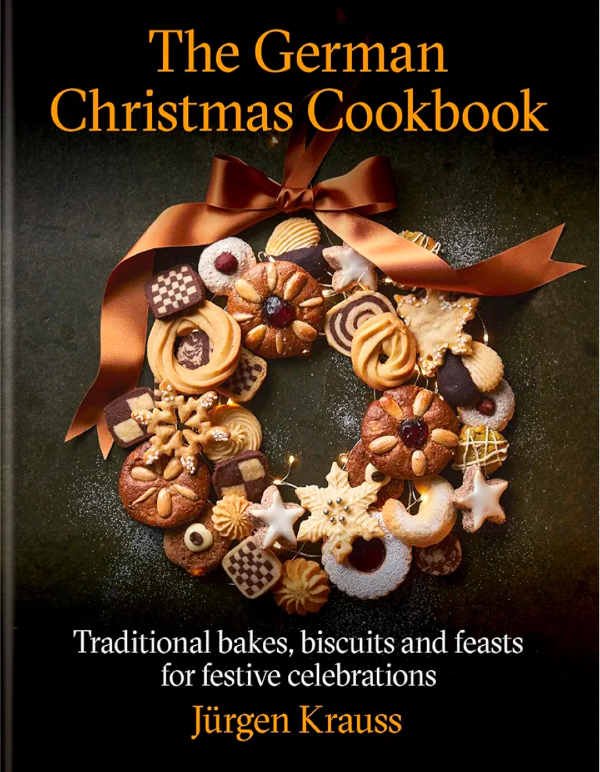
The German Christmas Cookbook: Traditional bakes, biscuits and feasts for festive celebrations by Jürgen Krauss is published by Octopus Books and is out now. This is a Bookshop.org affiliate link; if you buy from them, I will earn a (very small!) commission.
Murdoch Books recently published The Magical Christmas Cookbook with recipes inspired by market food. Yet I'd love to see a more in-depth non-fiction book on the subject, which would (of course!) include an expansively large German chapter.
I've unpaywalled an older post about Christmas cookbooks. You can read it here.
Thinking of signing up, but want to know more first? You can find out more here and there's a signup link at the bottom of the page.