"A bitter centipede if eaten in a pleasing berry pie will taste sweet" (Polish proverb)

My paternal grandfather had lost most of his fingernails. I say lost, but for all I know, he never grew them in the first place. He’d tell me off for biting my own nails, saying I’d end up like him, but whenever I looked at his fingers, all I could think about was how useful they’d be had he been a pie baker because I dislike the sensation of raw pie crust under my own nails.
My maternal grandmother baked great slabs of pie three times a week for my other grandfather to be served with stewed fruit and custard. She painted my sore nails with bitter aloe and removed her earthenware pastry bowl from the fridge where it had been cooling, repeating her piemaking mantra: “cold hands and warm hearts make the best pie!” I helped her bake despite possessing the hottest, driest hands womankind has ever seen. The state of my heart is for other people to judge.
What are pie hands? I have small paws, the kind of hand that can easily be slipped from handcuffs because the circumference of my wrist isn’t much smaller than the width of my hand. My fingers are short and capable and not the best for pie-making. Crumble does not tumble from them. My grandmother had slender and cool fingers, the kind that wore rings well. Pastry crumb fell effortlessly from them and gathered into a smooth ball under their touch. She felt the cold. I need to run my hands under a cold tap until they ache before I can go near an all-butter pastry.
I just came to bring y’all some pie crust crimping visual therapy.
— Charles Hunter III (@thesaltedtable) 6:12 AM ∙ Jun 3, 2021
I am reminded of my grandmother every time I read ‘American Pie’ by Pascale Le Draoulec, an account of a road trip around the USA in search of pie; Le Draoulec writes of finding a ceramic bowl whose crazed inner glaze tells a story of a woman’s wedding ring chinking against its surface as her fingers rub in then lift the mass of soft, fawn pastry. We create culinary desire lines all the time: those crazed paths are where our hands need to tread. Desire lines can explain conflicting pie advice: do we softly work the crust or use a firmer hand? Choose a food processor, rubbing in by hand or a pastry cutter? The furrows we plough in the crust and scratch into the glaze of a mixing bowl tell our story. Every competent pie baker has their own method. None are wrong. All are right if they give us what we’re looking for.
The tension between the restless searching that underpins the great American Road Trip and the circular completeness of pie is compelling. Le Draoulec’s journey towards pie has an apogee and perigee. Ours does too. We combine the fat and the flour. We disperse it into crumbs. We bring the whole back together again, and then we roll out, tuck in, and crimp. We seek to shape one form out of a disparate mass, but this is not a linear process. The pie crust rises in the oven then settles as it cools on a countertop. Sometimes there’s a gap between crust and filling, and sometimes they cosy up. Pie waxes and wanes whilst we trace and retrace the same old steps along new roads. We move from ‘I love apple pie the best’ to ‘my apple pie is the best to ‘your mother’s apple pie will never be the best’ to ‘your mother shouldn’t be allowed to bake apple pie’ and then wonder why it is so hard to move on from discrimination and hatred. This is Pie, and there are parts of its story that will not make you feel so good.
As a child, I had it inculcated into me that idea that Americans push on; the books of Laura Ingalls Wilder told me so. Her Ma baked pie but not always in any kind of kitchen or home we’d recognise. And clearly, Ma was not always happy about her husband’s need to keep moving west in search of new settlements. Le Draoulec is all about the journey too: towards the confident making of pie crust and towards love- or not? What does ‘to settle’ mean to a modern woman? How does a first-generation immigrant bridge the genealogical gap between a French apple tart and an all-American apple pie? She leaves space for the reader to think about all these things. We do not arrive at her destination before she does.
Wander all you like, but you and pie will find one another. Pie is both exoteric and extraordinary, as Edward Abbey makes clear when he said, “I once sat on the rim of a mesa above the Rio Grande for three days and nights, trying to have a vision. I got hungry and saw God in the form of a beef pie.”
Here are some of my other favourite writers on pie:
First, there’s Crockett Johnson and his divine book, ‘Harold and the Purple Crayon’:
“The sandy beach reminded Harold of picnics. And the thought of picnics made him hungry. So, he laid out a nice simple picnic lunch. There was nothing but pie. But there were all nine kinds of pie that Harold liked best. When Harold finished his picnic, there was quite a lot left. He hated to see so much delicious pie go to waste. So, Harold left a very hungry moose and a deserving porcupine to finish it up.”If you have very young children, this is a book for you.
Michael Lee West’s ‘Consuming Passions’ is not a book about pie per se but, inside, you will find a near-perfect piece of writing about the baking of key lime pie, yet it is about so much more. She calls key lime pie ‘a love enhancer’ and asks us to consider the shelf life of love (although the disgusting lime and coconut pie I made last week inspired little of the love stuff in my household because I burned the crust). She talks of the joys of stolen pie: “understand that theft may happen when your back is turned or right under your nose… meditate on the tenacity of thieves. Tell yourself that nothing is inviolate.” My pie was stolen away from us because of my carelessness.
I was sent a galley of ‘When Pies Fly’the second book on the subject by Cathy Barrow, and I swear to God reading it-and her first book, ‘Pies Squared’ (about slab pies)-makes my heart soar. In her second book, you’ll get to enjoy chapters on galettes, hand pies, pie poppers, strudel, puff and phyllo, empanadas, kolaches, filled and fried pies, knishes, and a complete guide to all the different crusts used. I mean, HOT CRAB DIP GALETTE!! And the photographs are an absolute joy. Buy both because these books are nourishment in every sense of the word. ‘When Pies Fly’ is out September 2019, and ‘Pies Squared’ with its Reuben, divine walnut baklava, and loaded baked potato slab pies and a glorious blackberry, sweetcorn, and basil version is out now.
I adore Kate McDermott’s comprehensive, beautiful and supportive pie book, The Art of The Pie and her latest, called Pie Camp. Here’s Kate’s website for all your pie needs including information about the pie camps she runs in the States and online.
Another joyous pie primer from Lisa Ludwinski is ‘Sister Pie’ from her eponymous bakery in Detroit, which operates as a triple-bottom-line business, supporting their employees, environment, and economy. Like Cathy Barrow’s books, you’ll find lots of advice and support whether you’re a novice or more experienced, and -most importantly- utterly delicious recipes for pie and its crust (I adore their buttermilk buckwheat galette dough, the coffee chess pie, the apricot raspberry rose galette, the salted maple pie, the concord grape and goat…I could go on…)
Sandra Gutierrez’s'Empanadas: The Hand-Held Pies of Latin America' is a useful reminder that pie transcends borders, and I love how she maps changes in the constitution of the dough from the plantains used in Latin Caribbean and Central America to Brazilian cassava in this interview.
‘Rustic Fruit Desserts by Cory Schreiber and Julie Richardson is a dinky little book packed with delectable recipes, some very quick to knock up; others take a little more time. Here, the definition of pie is broadened to include crumbles, buckles, pandowdies, cobblers, and slumps. The gingered peach and blackberry pandowdy has a simple single top crust and candied ginger in the filling (I have also used stem ginger), and I’m very fond of cooking with grapes. Hence, the grape galette is another favourite in our house. There’s also an extraordinary orange-flavoured apple custard pie which is perfect for winter.
How could I not include the film, The Waitress, here? The closing scene makes me howl (and I am someone who rarely cries) because the small girl in the film is the actual daughter of its director, Adrienne Shelley, who an intruder in her apartment brutally murdered just before the film’s release. Here we have pie baking as a salve, revenge, and catharsis in a relationship bruised by domestic violence (‘I Don’t Want Earl’s Baby Pie. ‘Naughty Pumpkin Pie’ are two of her pies). Ruby Tandoh writes about The Waitress in her book, ‘Eat Up’, and there’s an official tie-in to the film out too. I have yet to see it, although its author, Jenna Hunterson, inspired the film.
Just 64 pages long, but every one of them good, ‘Sweet Pies and Tarts’ by the ever-reliable Linda Collister and published in the nineties remains relevant today. Many of its recipes sound contemporary (apple and treacle tart, pine nut and honey tart, pear and almond cream pie); I will always use this book.
I have written about Beth Howard before here, but I need to mention her book yet again, all about complicated grief, pie, and building a new life after you’ve lost your husband. Her love story was not a smooth one, and it isn’t always the perfect love we grieve the loss of most.
Shauna Sever has a book out soon called ‘Midwest Made: Big, Bold Baking from the Heartland’. I haven’t read it yet, but Paula Howard mentioned it in her Twitter roundup of next season’s books, and I respect Howard’s judgement. Plus: MIDWESTERN BAKING ROCKS.
John T Edge has written an entire book about American apple pie.
Jus-Rol commissioned this survey on Britain’s favourite pie, but it does have some interesting images of pie landscapes created by artist Prudence Staite. And I am always amused by a passionate argument over what the best anything is. My best pie is whatever is good now, but I am superficial.
For some reason, this pie crimper makes me think of Molly O’Neill, who died recently. There’s a lot I could write about what Molly has done to help me on a personal level, but I don’t feel ready to do this yet. In the meantime, here’s one of her magnificent writings. Pie and moose and blueberries “like soft black peppercorns with an afterglow of fruit. Dearest Molly, you are so loved.
And while we’re remembering Molly, she edited American Food Writing: An Anthology of Classic Recipes, and it is a living memorial to her exquisite good taste. In it, you’ll find this essay by George Augustus Sala on the fetishisation of pie.
Rachel Roddy also loved Molly, and here is Rachel on the pie 'that has carried her through her life’. I think her voice is unique.
Here’s some troublesome pie: why the Milk Bar’s Crack Pie should-and has- been renamed.
“Cut my pie into four pieces, I don’t think I could eat eight.”
― Yogi Berra
“There is this myth, that America is a melting pot, but what happens in assimilation is that we end up deliberately choosing the American things - hot dogs and apple pie - and ignoring the Chinese offerings,” writes Amy Tan and when I came across this, I thought of writings on pie by Gustavo Arrellano, ‘The Boysenberry Pie of Bigotry’and Shameika Rhymes on pumpkin pie versus sweet potato pie and what is seen as ‘American’ and what is seen as ‘black American’. Betty Crocker described pie as ‘good eating in a good land’. Hmm.
Some rare images of the custard pie fight from Dr Strangelove, all deleted from the final cut.
A rich source of writings from Darra Goldstein (sub required); I love her on the subject of pie.
Daniela Galarza on everything you need to know about pie is a good read, although pie’s completeness is a trap designed to deceive us into thinking our knowledge is THE knowledge. Good pie gurus are legion. Listen to them all.
Rick Bragg about his mother’s pie, the pie that calls your name.
And the pies in Ernest Mickler’s ‘White Trash Cooking’ (vols 1 and 11) are the pies that sing to people across the USA. My writer and chef friend Elatia Harris knew Mickler: “Ernie had a hardscrabble childhood. He told me there weren't many toys. That they would tie on rags and make tails (and things that hung down in front) and swagger around with them. His Master's thesis was unlike any the art department had ever seen, and they didn't know how to read it. What was it? A beautiful memoir of an art-making boyhood in the swamp, of learning your colors from snakes and frogs,” she told me. Pie is art for everyone; Mickler knew this.
Every time I read the pie section in Eugene Walter’s‘The Happy Table’I laugh because every single recipe has alcohol in it, even the Sunday pie. Walter was a southern polymath who lived in Mobile, Alabama, and I highly recommend this book and his oral testimony (‘Milking the Moon’) as told to Katherine Clark.
An entire menu is dedicated to pies.
Pascale Le Draoulec inspired me to go in deep on Belgian prune pies in Wisconsin.
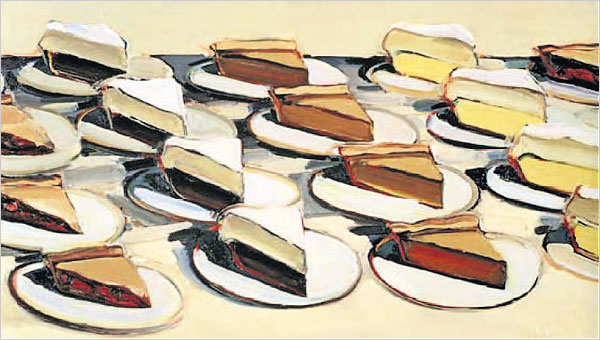
And the delicious pie life of artist Wayne Thiebaud whose art adorns this newsletter.